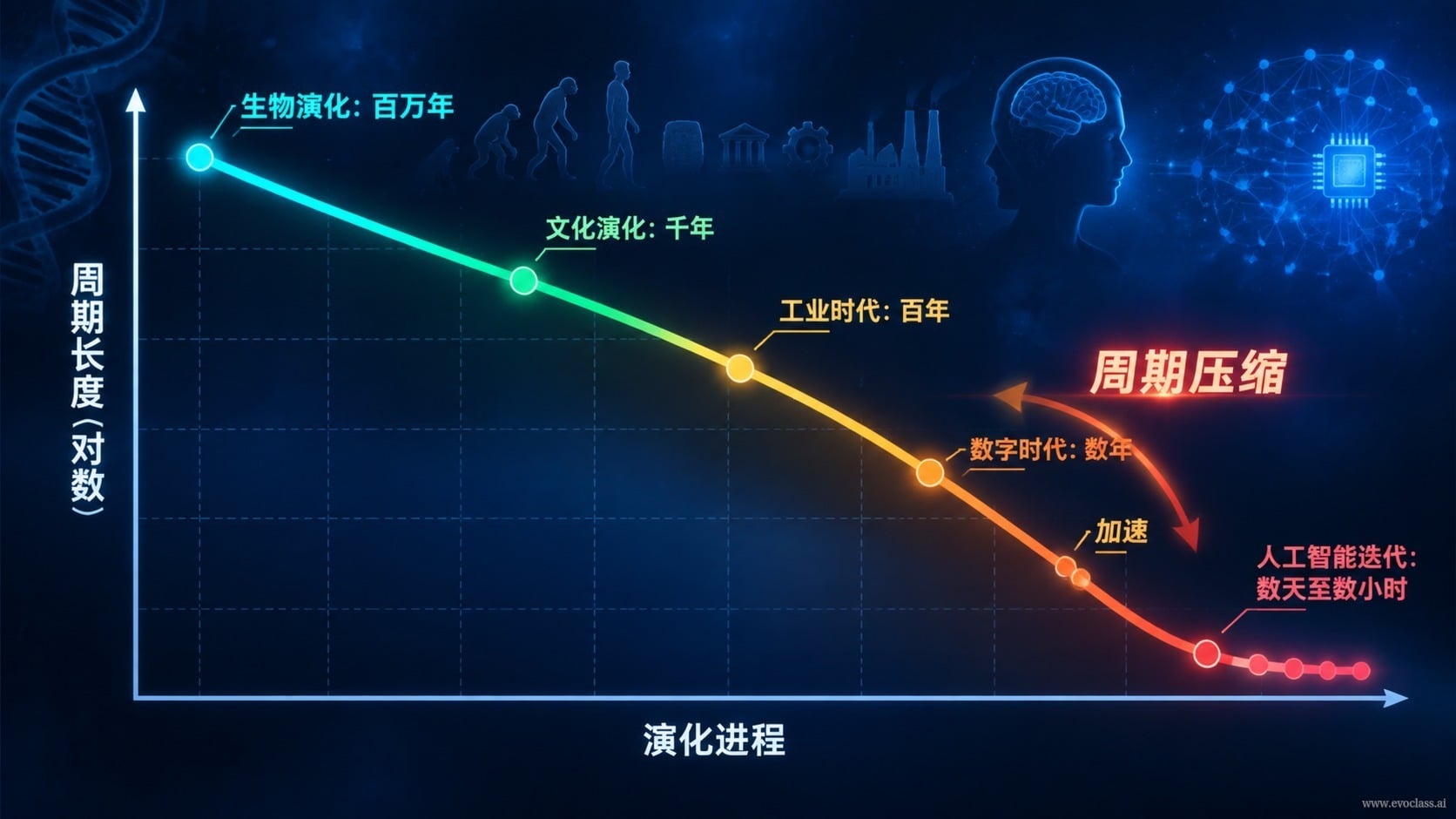
Spread the history of intelligent evolution across a single timeline, and what catches your eye first is not any particular event, but theshapeof that line: it is not a gently rising straight line, but a curve that hugs the ground for its first half and then climbs abruptly in its second. This page sets out to establish that very time scale—The Acceleration of Intelligent Evolution and Cycle Compression: evolution does not advance at a constant pace, but is an accelerating process driven by the replacement of carriers.
Two chains: carriers are migrating, cycles are compressing
The curve bends because two things are happening at the same time.
- Carrier migration chain: genetic accumulation → language and culture → software, compute, and artificial intelligence. Each migration changes the underlying condition of where information can live and how fast it can be copied.
- Cycle compression chain: generations → years → months → a single iteration. A complete round of "attempt—keep or discard" shrinks from being measured in generations to years and months, and finally down to a single generation, a single compilation, or one round of training and evaluation.
The two chains correspond one to one: whichever layer the carrier moves to, the cycle is compressed to the matching level. Remember one, and you can usually recall the other.
Why the curve climbs so abruptly
The acceleration is not because some single factor keeps pushing on its own, but because the loop of "trial and error—replication—selection" has itsunit costandunit durationcontinuously pushed down: candidates are ever cheaper to replicate, and each round of validation takes less time, so the number of attempts that can be completed per unit of time multiplies. This is the explanatory inference offered on this page, and it can serve as a focus for classroom discussion.
This leads to an important judgment:linear extrapolation cannot be used to understand this curve. Every time the carrier is replaced and the cost of a step drops by an order of magnitude, the slope of the entire curve jumps again. Predicting the future with past speeds will systematically underestimate the rise in the later portion.
The squeezed link: from generation to judgment
The shorter the cycle, the cheaper it is to "generate candidates"; but what truly decides success or failure is always "which candidate actually works." When the generation stage is greatly sped up, what gets relatively squeezed is precisely selection and validation—it shifts from an implicit premise to an explicit bottleneck. The gray dashed line in the figure that stays consistently above the blue stepped line represents exactly the relative lag of "the cost of selection and validation." This is the second judgment this page aims to establish:acceleration changes not only speed, but also the allocation of attention.
The acceleration curve and the two chainsThe first half of the curve nearly hugs the ground while the later portion climbs abruptly, showing that intelligent evolution does not advance at a constant pace but accelerates, driven by the replacement of carriers. As carriers migrate from genes and language-culture to software and compute, the corresponding trial-and-error cycle compresses from generations to years, months, and even a single iteration; when the cost of replicating candidates and of one round of validation fall at the same time, selection and validation become the relatively lagging bottleneck.